Tuesday, February 28, 2006

2/17-20/06: Bustamante, Mexico

February 17-20, 2006
Bustamante, Mexico - by Philip Russell
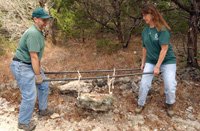
Over president's day weekend, ten trail tamers returned to Bustamante, Mexico. Bustamante, a charming little town older than San Antonio, is just 90 miles south of Laredo. In addition to offering challenging trail work, it has a mountain overlooking the town, springs on the order of Barton Springs, some fine 19th century architecture, pastries, and a distillery producing the local brew known as mescal. Our task was to upgrade a section of mountainside trail leading to a large cave that forms the heart of Bustamante's eco-tourism program. The work is challenging since all the plants are well equipped with thorns, large rocks abound, and soil is a scarce commodity to be sought out and brought back to the site in plastic buckets.


Fortunately, out previous work on the cave trail had weathered last year's hurricane that hit the area. We built on our previous work, filling, hauling, dragging, etc. and left the trail in even better condition for the anticipated rush of visitors over Easter. The Trail Tamer contingent was one of several work projects occurring simultaneously to enhance the cave. All projects were organized by the Texas Speleological Association, which also organized a variety of activities for participants on the second day of our stay.

On the second day, some of us went about 20 miles north to the small town of Candela, where we were greeted by the mayor who took us to a canyon being developed as a park. The tour included a scramble up a hillside to visit a mine that intersected a cave. The mine is no longer worked for its ore, but the bats inhabiting the complex do leave abundant guano which is collected, bagged, and then sold as fertilizer.
A second option involved an extended drive across the desert west of Bustamante. After passing through deserted ranch communities, participants arrived at the Chiquihuitillo Rock Art Site. There, under the shelter of overhanging cliffs, are dozens of Indian rock paintings. Little information is available as to who made the paintings, or when the many geometric shapes were painted.

A third excursion involved a scramble up the canyon at the foot of the mountain where we did the trail work. This excursion provided a good chance to observe desert vegetation and experience hiking along a trail built not for recreation but to carry ore from the mine to the rail line. At the end of the trail was yet another mine-cave complex. (The area is so full of caves that it's hard to open a mine without encountering a cave).

On our last night we had a banquet organized at the funky hotel where we stayed. The following morning we drove back to Austin, after touring the local mescal distillery.

Monday, January 30, 2006

2/17-20/06: Davy Crockett National Forest

February 17-20, 2006
Davy Crockett National Forest - by George Boemerman
Friday morning, the 17th of Feb., Steve Baker, George Boemerman, Bo Bosarge, Ray Fore, and Chuck Lundstedt rendezvoused at the Ratcliff Lake office of the Davy Crockett National Forest with Pearlie Green and Merlinda Schory, the trails maintenance supervisors at the forest, to plan and prepare the weekend's workload.

Pearlie and Merlinda had selected 5 bridges to repair so we drove to those sites to determine the extent of work, plus the tools and materials required. We then drove to the forest's work area and prepositioned the lumber, materials and tools on the work trailers so we'd be ready to go the next morning.

We decided to break into 2 teams, possibly 3 depending on how things worked out, with Steve Baker and Ray Fore as our construction team leaders. Note that Steve Baker briefed us on the trail bridge construction and repair procedures he found in a National Forest publication and they proved quite valuable. Great job, Steve.

That evening Janette Barlow and Terence Donovan of the Trail Tamers arrived, plus 4 AmeriCorps members: Leslie Huvler, Brandon Kiger, Scott Voorhees, and Chad Wilbur. Chuck brought a pickup load of good firewood so we had great campfires, and that night Chuck and Ray prepared gumbo for us.

Saturday morning we awoke to find the forest frozen over. Since we had selected the overflow campsite with its covered pavilion, we were able to prepare and eat breakfast in relative comfort. Then off to the woods we went. Since the bridges were frozen over, we could not walk on them (too slippery) so we had to do most of the work from the sides.

In the afternoon it thawed so we were able to complete laying the bridge treads. By the end of a long day we were able to complete all 5 assigned bridge projects. Again, Saturday night we had a great and welcome campfire. The camp host had prepared it in advance for us. Steve Baker prepared a wonderful and warming dinner of jambalaya. Pearlie Green joined us along with the 4 camp host families who also prepared dishes for all to share. It may have been a bit chilly but it did not dampen our spirits one bit. Around the campfire we planned the next day's work (3 additional bridge repairs) and the next day we finished those.

The entire weekend was damp, cold, sometimes freezing but we all had a good time (we must be a bit nutty) and were able to complete all tasks safely and in the usual Trail Tamer professional fashion. We all noted the spirit, work ethic and teamwork of the AmeriCorps folks. A great group, we would take them on any trip.

1/21/06: Bamberger Ranch Preserve

January 21, 2006
Bamberger Ranch Preserve, Texas - by Lynda DeGroot
On a fairly cool and overcast January morning, 15 Trail Tamers from Austin, Round Mountain, Wimberley and as far as Laredo(!) made their way to the beautiful Bamberger Ranch Preserve near Johnson City, Texas. We came for the purpose of modifying the trail to the Chiroptorium (J. David Bamberger's man-made bat cave) and repairing several other nature trails nearby.

We gathered in front of Hes' Store (a unique replica of an old general store) and waited for Steve Fulton to bring the Bluebonnet trailer to transport everyone to our appointed tasks. We were joined by 7 other people who traveled from Blanco, San Antonio and Dallas upon hearing about this project from the Bambergers.

Steve dropped us off at the bat cave and we promptly sized up the situation and then set to work trimming vegetation, widening the trail, and reinforcing it with numerous large rocks. In order to get more tasks done, Steve took about half of the crew to two other sites where they went to work putting in steps near the creek, clearing overgrown vegetation and making other necessary repairs.

When we had completed much of what we had set out to do by that afternoon, we rounded everyone up and hopped back on the Bluebonnet and headed to Hes' store where refreshments were waiting! We were treated to a fine "snack" of tamales, beans, chips and salsa prepared and served by J. David Bamberger with his assistant, Colleen Gardner, helping. As always, we enjoyed the camaraderie and listening to J. David's stories, and are looking forward to the next time!

Saturday, December 10, 2005

BLAZING THE TRAIL FOR BEGINNERS

"Trail Taming Techniques" classes recognized by Austin American-Statesman

Saturday, December 10, 2005
"BLAZING THE TRAIL FOR BEGINNERS"

Group that builds, maintains trails in parks also trains home gardeners to create paths through their landscapes.

Winter is a great time to ponder building a path in the Central Texas landscape. The pondering part is important, especially in an erosion-prone region where a gullywasher can quickly obliterate a poorly planned trail you've worked so hard to build.

Enter Central Texas Trail Tamers, a group that has built and/or maintained trails in state parks and other public places in Texas, Wyoming, California and Mexico. The organization now offers lectures and hands-on workshops for those who would like to move past the pondering process, but aren't sure how.

"This trail-building stuff is not rocket science; it's just sort of a lost art," says trail tamer Dave DeGroot. "To be sustainable, you need to think quite a bit before you start digging up the earth."

True, you might not need that much expertise if your plan involves laying stepping stones in a small backyard. But plenty of people with Hill Country ranchettes, and urban dwellers who want to make their large lots or steep hillsides more inviting, could benefit from the wisdom acquired by these trailblazing experts.

DeGroot recently led about a dozen people through a recent Friday night class and Saturday trail-building excursion at Wild Basin Wilderness Preserve.

The first lesson: Study the land and the creatures that inhabit it; then plot a design that connects the entire habitat instead of chopping it up into disparate pieces, DeGroot said.

While a field that's naturally clear of trees and fairly level might seem like a logical place to build a trail, it can quickly become overgrown, he said. On hillsides, trails that zigzag (switchback) tend to wash out less than those that head straight down.

Pre-existing trees and vegetation will obviously have an impact on where your trail goes. Most people want to preserve as much natural habitat as they can — and if you share living quarters with an endangered species such as the golden-cheeked warbler, it might even be illegal to disturb the tree canopy on your property.

But if you plan to trim trees, DeGroot said it's sometimes better to remove them altogether than to prune haphazardly. He also recommends removing all bushes within one foot of either side of the trail, including small ones that don't seem like they're in the way. Little bushes become big bushes quickly, and their root systems can disturb the trail as it grows, he said.

Directing water where you want it is another important factor in building trails that will hold up over time in all kinds of weather. In general, the idea is to encourage water to flow across the trail, instead of following its path. If building on a hill, it makes sense to preserve the original drainage of the slope, and to make sure there's someplace lower than the trail for water to go.

DeGroot said you accomplish that by building trenches (two shovels wide) on either side of the trail, by raising the level of the path or doing both. A common mistake that novices make: building trails and trenches that are too narrow. Another big mistake: failing to remove grass or leaves from the trail before piling on surface materials, such as crushed rock, which has a tendency to slide off the loose debris.

"You can't just cheat," said DeGroot, "or you'll be back there next year again."

The hands-on Saturday morning session has several purposes - to move trailbuilding out of the theoretical and into the more strenuous reality for those with paths in their futures; to give the Trail Tamers a shot at attracting new members who will have trailbuilding skills; and to upgrade trails at Wild Basin.

The two-day workshop costs $10, and Central Texas Trail Tamers plans to offer it on the second weekend of each month. E-mail registration information at planning@trailtamers.org or call 394-9998. The group's Web site is www.trailtamers.org.


Tools for building, maintaining trails

Building a trail is a substantial project, and the tools you've acquired for casual piddling in the yard might not hold up to the task. Most of the tools DeGroot recommends -many of them designed to be used in fighting forest fires - are occasionally available locally at home improvement centers or farm and ranch supply companies. They can also be ordered online, he said.

Among his must-have implements: a Pulaski or fire ax for chopping tree roots, a fire rake for removing leaves and other loose materials from the path, and a rock cradle, which allows heavy boulders to be rolled into a net 'cradle' which can then be moved by several people. Find more information on tools at www.americantrails.org.
By Julie Bonnin, Austin American-Statesman

Thursday, October 20, 2005

10/8-15/05: Ouachita National Forest, Western Arkansas

October 8-15, 2005
Ouachita National Forest, Western Arkansas - by Steve Baker
The theme for this years Trail Tamers trip to the Ouachita National forest must be, "Sometimes life has other things planned for you." Our trip leader, George Boemerman, did the pre-trip planning and communications but on Saturday, October 8, got a call that he was needed in Virginia due to a family medical emergency. That left Chuck Lundstedt, Terence Donovan, Rocky Nelson, and me. I agreed, earlier in the planning, to carry the kitchen tent and cooking gear. We had the necessities to make our camp, but we knew we would miss "Boemer".

Our Forest Service contact, Paul Tankersley, arranged for us to stay in the Queen Wilhelmina State Park that is within the Ouachita National Forest. We were assigned to the "overflow" camping area that turned out to be a large, beautifully manicured lawn across the access road from the RV campsites. We were within twenty yards of the exceptionally clean bathhouse with easy access to electricity and water. The views were excellent and one of the nicest car camping environments one could ask for. The park also has a lodge with a very nice restaurant which we visited our final evening in camp.

We arrived Sunday afternoon and set up camp. Later that day our Forest Service trail crew leader, Tom, stopped by to fill out paperwork and coordinate for the weeks work. We agreed that he would meet us at camp Monday morning at 0700 and we would drive to the first work site that was about 10 miles east of the park.

Tom arrived at 0630 Monday morning and we were on the road by 0645. We parked at the Foran Gap trailhead, gathered our tools and hiked in just over a mile to the first project planned for us; a 200 yard long reroute of the Ouachita Trail. Tom had flagged the route but everything from brushing the line to final tread cutting needed to be done. We soon discovered that the predominant flora in the area is poison ivy so long sleeves were necessary. Rocky knew himself to be prone to ivy reaction; the rest of us would find out later in the week. We worked steadily all day and had the majority of the reroute cut by that evening but would require half a day on Tuesday to haul dirt from the back slopes to fill in tread over rocky areas. On the way back to camp, we went through Mena, AR to stop at the Wal-Mart and buy additional long sleeve shirts and hydrocortisone ointment.

Tuesday we returned to complete the previous days work and had it done by lunch. Tom had to work elsewhere but had flagged out sections of the trail for about a mile further in that needed water bars and re-tread work. We hiked in to the end of the marked area and began work on those sections. Due to the remoteness of the area, we were able to cache our tools and didn’t have to carry them in and out each day.

By Wednesday morning both Rocky and Terence were showing signs of poison ivy contact on their arms, in spite of wearing long sleeves, but neither complained or missed a beat of work. Chuck and I never did have any reaction. Wednesday and the first half of Thursday were similar work in the same area; re-treading sloughed in sections of the trail, building water bars and reinforcing drainage crossing. The final total for that section was 200 yards of new trail, 6 water bars, two reinforced drainage crossings and almost two miles of restored trail.

Thursday afternoon we relocated to another section of the O.T. closer to Queen Wilhelmina. This section was steep and rocky with some badly eroded areas. Tom marked the location of many needed water bars and areas that needed to be repaired. We completed several water bars but decided to knock off an hour early; we came out about 3:30 PM.

Traditionally on these trips, Friday has been an off day but Chuck, Terence and I decided to work at least part of the day. Rocky said it was "time to see his bride" and left Friday morning. The remainder of us worked until about 1:30 PM having completed an additional 10 water bars, one drainage crossing and more retread bringing the trip total up to almost 3 miles of trail worked in 140.5 man hours. We returned to camp to load up the kitchen tent and gear. We treated ourselves to a restaurant meal at the lodge that evening, a nice buffet.

Paul and Tom came by the camp Friday evening to thank us for the work and indicated we would be welcome to return.

This is an excellent venue for those wanting to do some badly needed, serious trail work but still like a shower in the evening. Try to include it in your plans for next year.